
The Evzones: A Complete Guide to Greece’s Presidential Guard
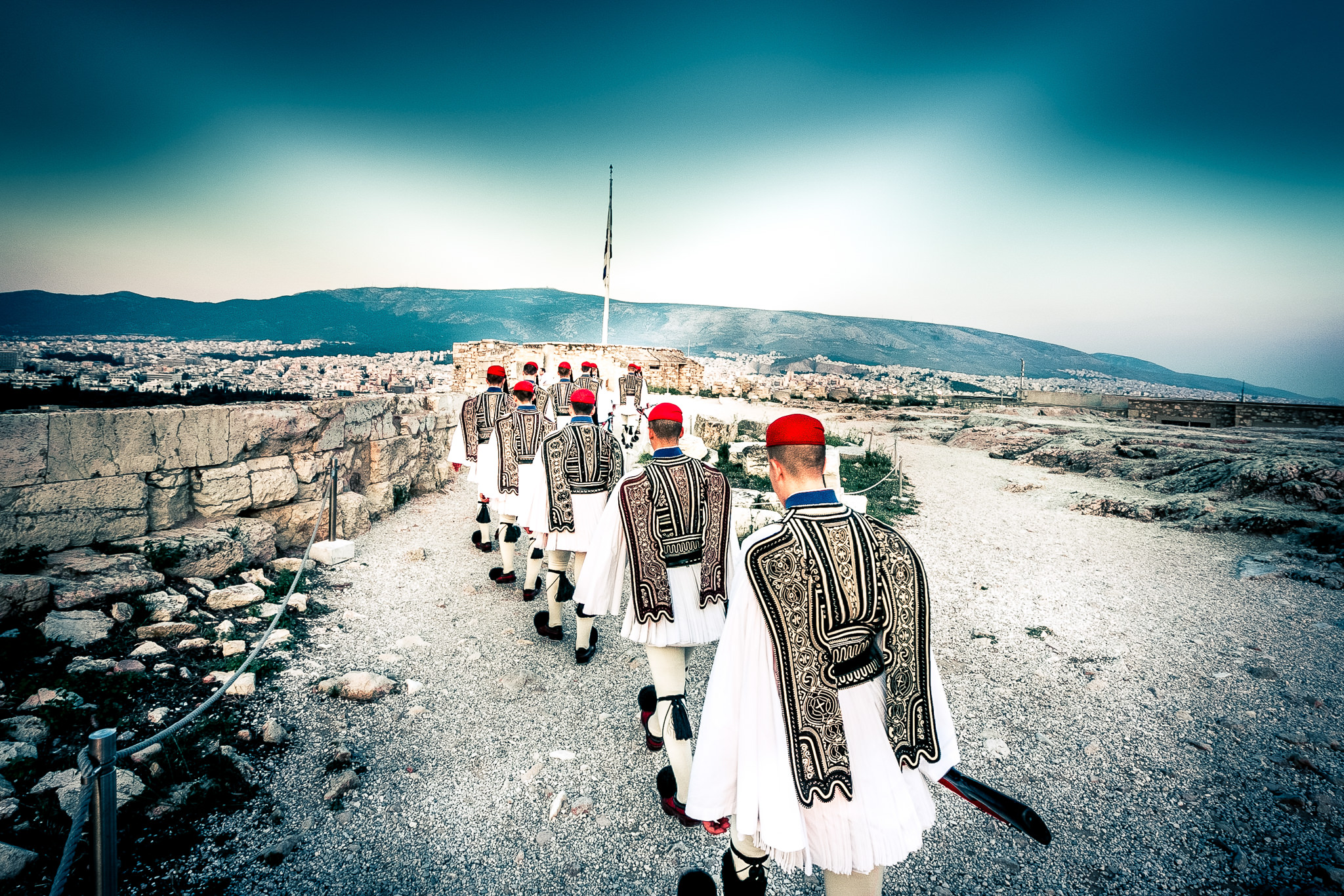
I first met the Evzones in 2016, when a detachment of Greece’s Presidential Guard came to Sydney for the Anzac commemorations. Over the next seven years, I was granted rare, behind-the-scenes access to all areas of the Garrison in Athens and to the ceremonial duties the Evzones perform every day. I spent days on end, from morning to night, with Greece’s most beloved sons, and those photographs became The Evzones Collection.
At the foot of the Hellenic Parliament in Athens, two soldiers stand completely still in front of the Tomb of the Unknown Soldier. They wear white pleated fustanellas, red farion caps with long black tassels representing tears and mourning for those who lost their lives during Greece’s liberation, and red tsarouchia topped with black founta. They are the Evzones, the soldiers of Greece’s Presidential Guard. They are often described as Athens’ most photographed sight after the Parthenon.
To many visitors, they look like a beautiful piece of theatre. To Greeks at home and across the diaspora, they are something far deeper: a living link to the fighters of 1821, and a daily act of respect for everyone who has died for Greece. In this guide, I explain who the Evzones are, where they came from, what each part of the uniform means, when to see the changing of the guard, and how a young conscript becomes an Evzone.
Quick facts
- Unit: Presidential Guard (Προεδρική Φρουρά), a ceremonial unit of the Hellenic Army
- Founded: 1868, by Royal Decree of King George I
- Posts: Tomb of the Unknown Soldier (Syntagma Square), Presidential Mansion, and the gate of the Presidential Guard barracks, Athens
- Hourly change: every hour, on the hour, day and night
- Sunday ceremony: 11 am, with a large contingent and military band
- Fustanella: about 30 metres of white fabric, 400 pleats
- Tsarouchia: about 3 kg a pair, according to the Presidency of the Hellenic Republic
What does "Evzones" mean? Key Greek terms
The word Evzones (Εύζωνες; singular Εύζωνας, Évzonas) comes from the ancient Greek εὔζωνος (eúzōnos): eu, "well", and zōnē, "belt" or "girdle". It means "well-girded". The word first appears in Homer’s Iliad, and ancient writers later used it to describe lightly armed infantry. The Presidency of the Hellenic Republic notes that the belt of today’s uniform still marks the "well-girdled" fighter.
These are the terms you’ll hear most often, and the ones I use throughout this guide:
- Εύζωνες (Évzones): the Evzones; also written Evzonoi (Εύζωνοι)
- Τσολιάς / Τσολιάδες (Tsoliás / Tsoliádes): the everyday, affectionate word for an Evzone, or for anyone in the traditional costume. Many Greek boys dress as tsoliades on Greek Independence Day.
- Προεδρική Φρουρά (Proedrikí Frourá): the Presidential Guard
- Φουστανέλα (foustanéla): the pleated white kilt, usually written fustanella in English
- Τσαρούχια (tsaroúchia): the red leather clogs with black pom-poms (founta)
- Μνημείο του Αγνώστου Στρατιώτη: the Tomb (Monument) of the Unknown Soldier
A history of the Evzones, 1868 to today
From light infantry to an elite guard
The name was reintroduced during the Greek War of Independence. In 1824, the new Greek regular army designated one company of its first infantry battalion an "Evzone Company". Over the next decades, "Evzones" became the Greek term for light infantry, equivalent to riflemen or chasseurs in other European armies. The Rumeliote fighters who had made up much of the revolutionary forces resisted Western-style uniforms, and units dressed in the traditional fustanella were formed to recruit them.
The Presidential Guard traces its own history to 1868. On 12 December of that year (24 December in today’s calendar), King George I signed the Royal Decree establishing an escort unit known as the Agema. It consisted of two Evzone infantry companies and a cavalry company. The Presidency of the Hellenic Republic describes this first unit as a "combatant and ceremonial elite unit" of soldiers who had shown bravery and military virtue, intended as a model for the rest of the army.
Evzones in battle
Evzones were never only ceremonial. Evzone battalions fought in the Greco-Turkish War of 1897. During the Balkan Wars of 1912–13, they fought at the front and on the army’s flanks and suffered heavy casualties. Evzone regiments then fought as elite shock troops in the First World War, the Asia Minor campaign of 1919–22 and the Greco-Italian War of 1940–41. That fighting record is a major reason the uniform still carries such weight in Greece.
Palace Guard, Royal Guard, Presidential Guard
The guard’s name has followed Greece’s many regime changes. In 1914, after the Balkan Wars, the unit was renamed the Palace Guard. In 1929, when construction of the Tomb of the Unknown Soldier began, a company of Evzones, the "Guard Company of the President of the Republic", took over guarding it. The Tomb was inaugurated on 25 March 1932, Greek Independence Day. The guard later became the Royal Guard Company (1940), the Guard of Honour of the Unknown Soldier (1941), the Flag Guard (1942) during the Axis occupation, and the Royal Guard again in 1946.
When democracy was restored in 1974, the unit took its present name, the Presidential Guard. Its role is now purely ceremonial, and the Military Office of the Presidency of the Republic supervises it. The barracks, named after George Tzavelas, a hero of the 1821 revolution, stands on Herodou Attikou Street beside the Presidential Mansion.
The Evzone uniform, piece by piece
According to the Presidency, the uniform of the military leaders and fighters of the 1821 revolution became Greece’s official national attire. The Presidential Guard makes every piece of the Evzone uniform by hand in its own workshops, using natural materials such as wool, cotton, and silk. The full ceremonial dress is worn on Sundays, on national holidays, and for official occasions. Here is what each piece is and what it means.
- Farion (φάριον), the cap. A red cap carrying the national emblem, with a long black silk tassel. The Presidency explains that the red represents the blood spilled in the struggles for liberation, and the black tassel represents tears and mourning.
- Ypoditis (υποδήτης), the shirt. A white shirt with very wide sleeves. Like the fustanella, its white symbolises the purity of the struggle for independence.
- Fermeli (φέρμελη), the waistcoat. Hand-embroidered in white or gilt thread with culturally and folklorically significant designs. The Presidency calls it the most difficult part of the uniform to make, and as I understand it, each one takes about six months.
- Fustanella (φουστανέλα), the kilt. Made from about 30 metres of white fabric with 400 pleats, which represent the years of Ottoman occupation.
- Krossia (κρόσσια), the fringes. Blue and white silk fringes that symbolise the Greek flag.
- The belt. The cartridge belt gives the "well-girded" Evzone his name.
- Periskelides (περισκελίδες) and garters. White woollen stockings held in place with black silk garters.
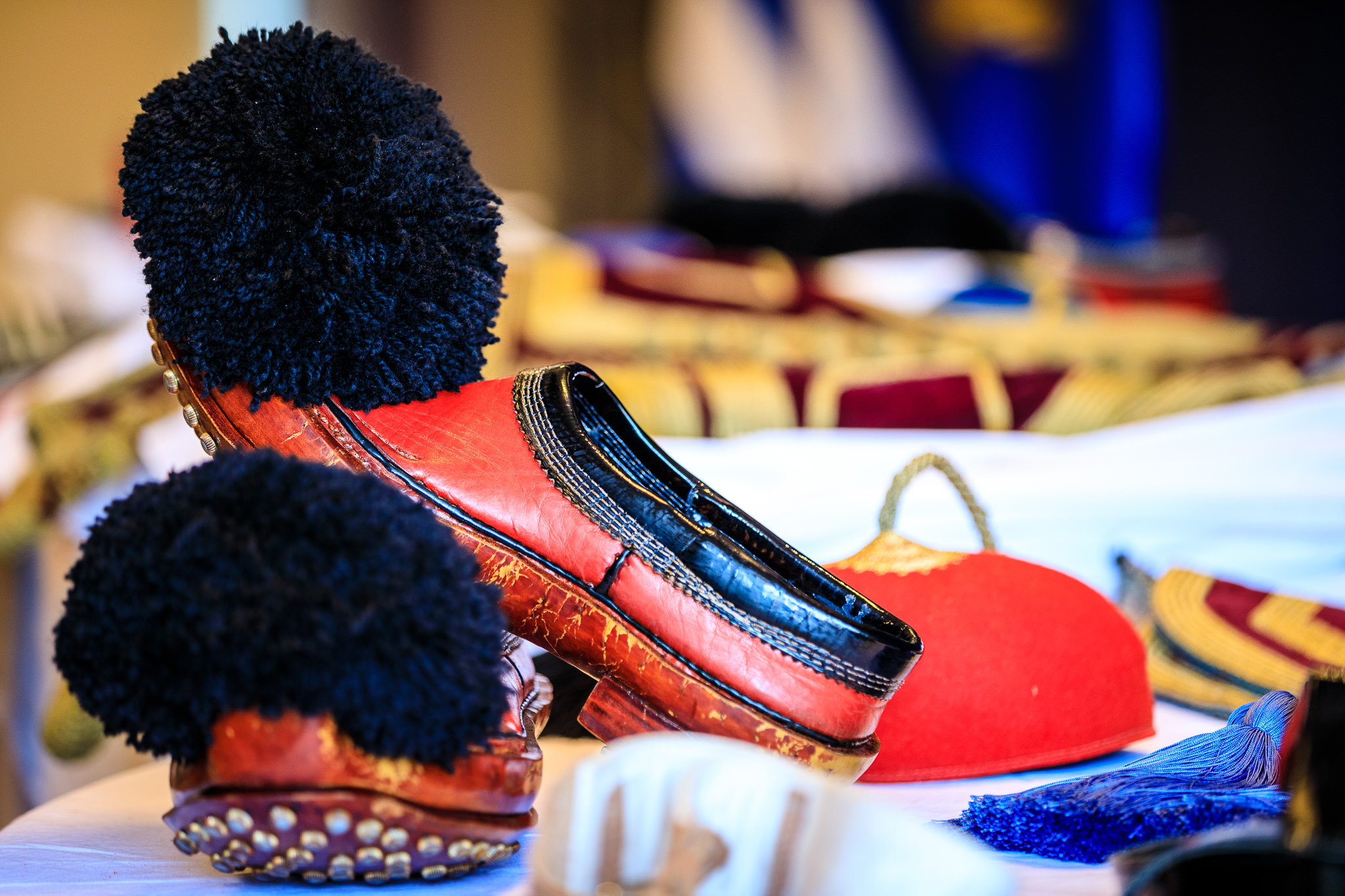
- Tsarouchia (τσαρούχια), the clogs. Hand-made from hard red leather with a large black pom-pom (founta) on the upturned toe. The Presidency estimates the weight at about 3 kg per pair, with around 120 nails in the soles. Other sources quote slightly different figures (60 nails, or 3.5 kg a pair), so treat the numbers as approximate.
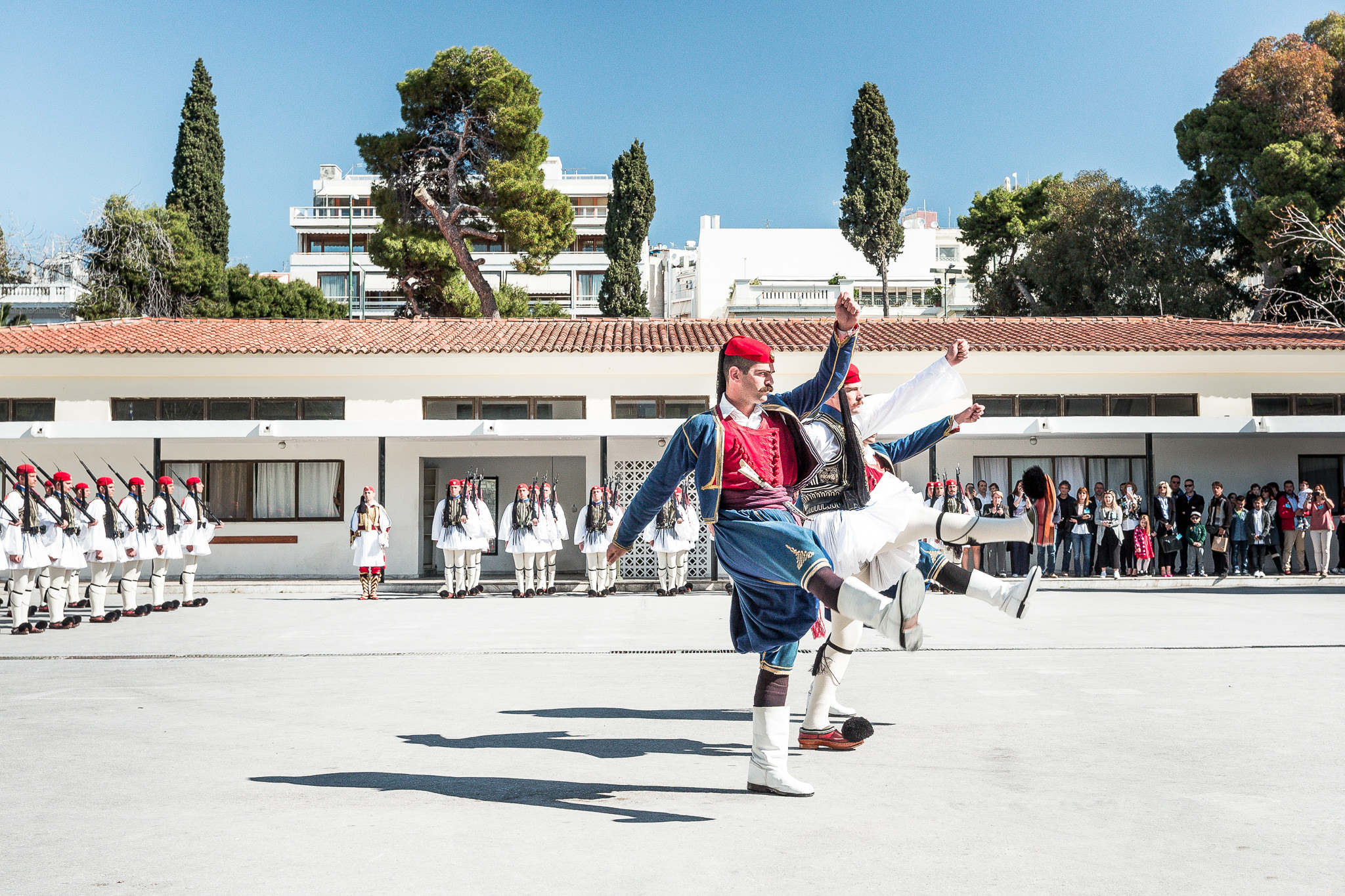
The Evzones don’t wear the fustanella every day. In winter they wear the navy-blue doulamas, a long tunic modelled on the uniform of the Macedonian Struggle. In summer they wear a khaki doulamas that recalls the Balkan Wars. The Guard’s wardrobe also includes the Cretan uniform and other regional costumes, including Pontian, Thracian, and Aegean island dress, worn on memorial days and special occasions. Officers wear a longer fustanella and a more elaborate fermeli.
Why do the Evzones wear skirts and pom-poms?
The "skirt" is the fustanella, the traditional dress of mainland Greek fighters during the War of Independence. The Evzones wear it because it is the uniform of the men who won Greece its freedom. Its 400 pleats commemorate roughly four centuries of Ottoman rule.
The pom-poms (founta) on the tsarouchia are traditional too. The Presidency records the tradition that the large black tassel hid a blade for close combat. Other accounts say it helped keep the foot warm on campaign. The nailed soles gave the mountain fighters grip on rough ground. Today they give the ceremonial stamp its sharp, ringing sound.
The slow, high-stepping march and forceful foot strike are part of the ritual. There is also a tradition I like to share: the Evzones stamp so the fallen heroes can hear the guard is still standing watch over them.
The changing of the guard in Athens: times and where to watch
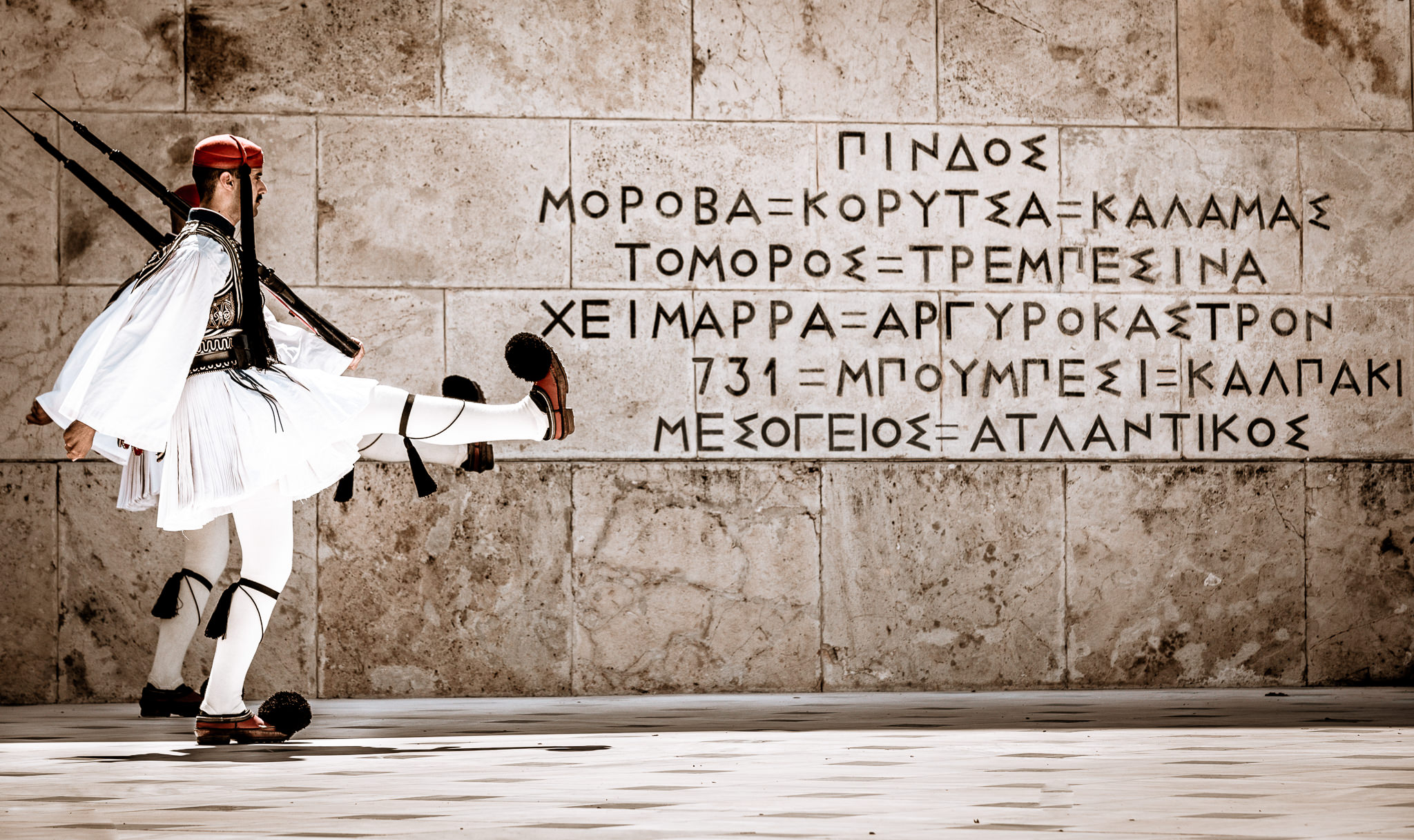
Every hour, on the hour. According to the Presidency, the Evzones guard the Tomb of the Unknown Soldier around the clock, in all weather, and the pairs change every hour. The change takes several minutes. The two incoming and two outgoing guards perform slow, mirrored movements under a corporal’s supervision.
Sunday at 11 am. Every Sunday at 11:00, a large contingent of Evzones, accompanied by a military band, marches from the Presidential Guard camp to the Tomb for the official changing of the guard. On this day, the guards wear full ceremonial uniforms with fustanellas. The parade comes down Vasilissis Sofias Avenue, and travel guides suggest arriving by about 10:30–10:40 to get a spot near the front.
Where to watch. The Tomb sits in front of the Hellenic Parliament, across Vasilissis Amalias Avenue from Syntagma Square. Watching is free. Evzones also guard the entrance to the Presidential Mansion on Herodou Attikou Street, a short walk away beside the National Garden.
Photos and etiquette. As a photographer, here is my advice. You’re welcome to take photos, and plenty of visitors do. Stay behind the barrier, don’t touch the guards or their uniforms, and follow the directions of the soldier in ordinary uniform who keeps the area clear. The Evzones on duty will not react. Their stillness is the whole point of the post.
The Evzones also raise and lower the flag on the Acropolis’s Sacred Rock on Sundays and official holidays. They serve as honour guards when foreign heads of state visit and when ambassadors present their credentials to the President.
How do you become an Evzone? Selection and training
The Presidency says Evzones are volunteers from the Hellenic Army’s Infantry Corps. In practice, they are young men doing their national service. Candidates are identified during basic training, and first-hand accounts say Presidential Guard officers visit regularly to select them.
Height comes first. A minimum of about 1.87 metres is widely reported, and guards are paired with partners of similar build so that they mirror each other perfectly. Candidates must be physically and mentally fit, and they must also be Orthodox Christians. Training is demanding and often silent. Recruits learn to stand completely motionless, starting with a few minutes and building up to two hours or more. They also drill the slow, synchronised steps of the change for hours a day. Accounts from former guards suggest that up to half of the selected candidates don’t complete the training.
Guard life means early starts, daily physical training and several shifts a day, often overnight. When an Evzone finishes his service, he hands his uniform and tsarouchia on to a new recruit, so each set carries its own history.
Evzones abroad, from New York to Melbourne and Sydney
Detachments of the Presidential Guard regularly take part in commemorations outside Greece, most notably the Greek Independence Day celebrations on 25 March. In the United States they have marched in New York and Chicago.
Australia, my home and home to one of the world’s largest Greek communities, has welcomed the Evzones several times:
- Melbourne: Evzones visited in 1980 and 1992. In March 2018, they led the Greek National Day parade at the Shrine of Remembrance in front of thousands of people. They returned from 21 to 29 April 2022 to mark the bicentenary of Greek independence and to take part in Anzac Day commemorations. The Greek National Day Council Victoria delivered the visit.
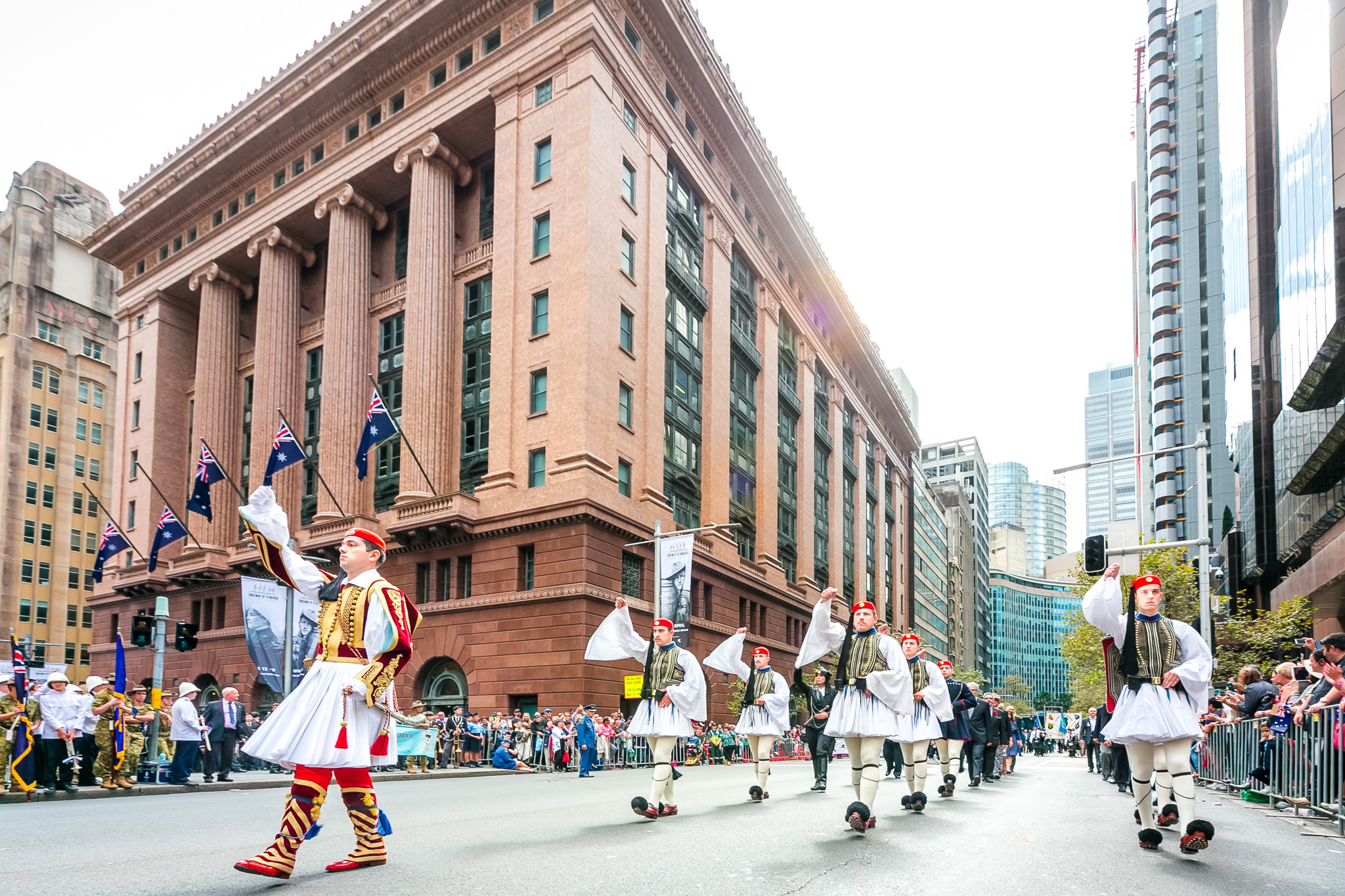
- Sydney: In April 2016, a detachment came to Sydney for the 75th anniversary of the Battle of Crete and the Anzac commemorations, at the invitation of the Hellenic Club Sydney. With special permission from the RSL, the Evzones mounted a guard at the Martin Place Cenotaph from 20 to 22 April. That was the visit where I first met them. They have since returned in 2017, 2018 and 2025.
- Adelaide: Members of the Presidential Guard have also visited Adelaide.
For Greek Australians like me, these visits are moments of enormous pride.
Photographing the Evzones: The Evzones Collection
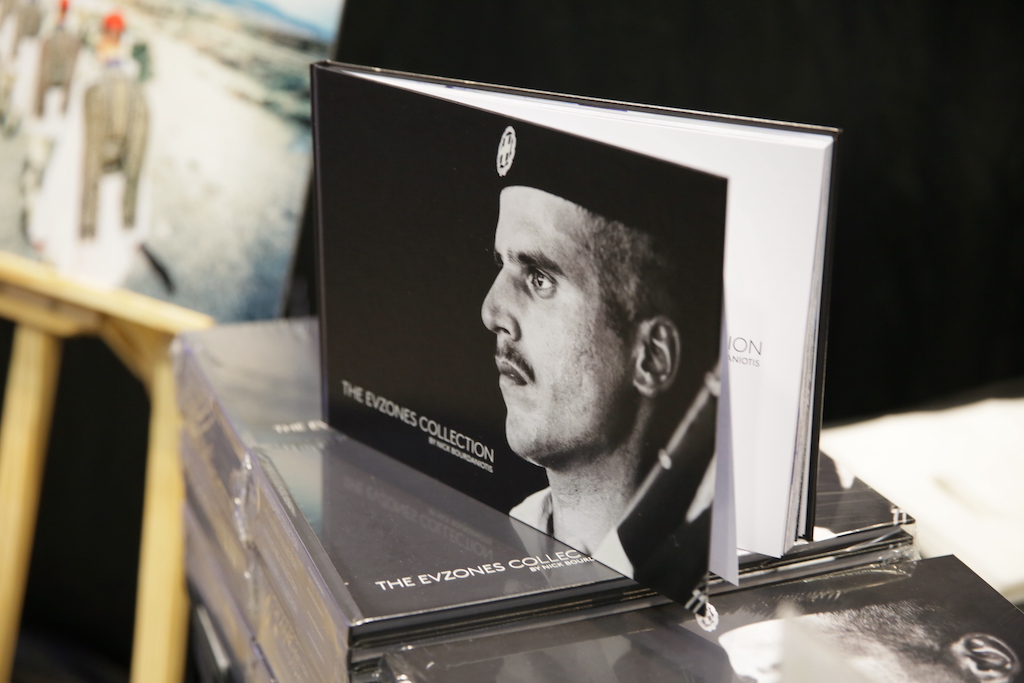
I’m Nick Bourdaniotis, a Sydney photographer, and my own story with the Evzones began during that 2016 visit to Sydney. Over the next seven years, I was granted rare, behind-the-scenes access to all areas of the Garrison in Athens and to the ceremonial duties the Evzones perform every day. I followed them again when they returned to Melbourne and Adelaide. I tried to capture photos that are not common amongst those who have photographed them before at their post or at the Tomb of the Unknown Soldier, and instead to show them in places where very few are privileged even to get a glimpse of them, doing things that most people are not even aware they do. The resulting body of work became The Evzones Collection by Nick Bourdaniotis. My photographs also appear in the book the Presidential Guard published for its 150th anniversary.
My exhibition opened in Sydney in February 2021 for the 200th anniversary of the Greek Revolution and has since toured Australia, with more than 7,000 visitors. In March 2023, it was shown at the Athens War Museum under the patronage of the then President of the Hellenic Republic. On 19 December 2023, I donated the entire Athens exhibition to the Presidency for permanent display in the Presidential Palace and at the Evzones’ headquarters. In 2024, my photograph "Spectrum of the Sacred Guard" won a gold medal at the European Photography Awards.
You can see my work in the Evzones gallery, own the whole exhibition in the Evzones Collection coffee table book, or choose a fine art Evzones print for your home. Read more about me.
Frequently asked questions about the Evzones
What time is the changing of the guard in Athens?
The guards change every hour, on the hour, 24 hours a day, at the Tomb of the Unknown Soldier on Syntagma Square. The full ceremony with a military band takes place every Sunday at 11 am.
Why do Greek guards wear skirts?
The “skirt” is the fustanella, the traditional dress of the Greek fighters of the 1821 War of Independence. It is made from about 30 metres of fabric, and its 400 pleats represent the years of Ottoman occupation.
Why do the Evzones have pom-poms on their shoes?
The tsarouchia are traditional mountain footwear. Tradition says the large black tassel hid a blade for close combat.
How heavy are the Evzones’ shoes?
About 3 kg a pair, according to the Presidency of the Hellenic Republic, with around 120 nails in the soles.
How do you become an Evzone?
Evzones are volunteers from the Hellenic Army’s infantry, selected during national service. They must be tall (around 1.87 m minimum is widely reported) and physically and mentally fit, and they must complete demanding training in stillness and precision drill.
Can you take photos with the Evzones?
Yes. Photos are welcome, but stay behind the barrier and never touch the guards or their uniform.
Have the Evzones been to Australia?
Yes. Presidential Guard detachments have visited Melbourne, Sydney, Perth and Adelaide, including for Greek Independence Day and Anzac Day commemorations. In late October 2026, they will visit Sydney and Canberra.